
Building a mobile app isn't just about writing code; it's about how that code gets built, tested, and delivered.
The methodology a development team chooses shapes everything from timelines and budgets to how well the final product actually matches what the business needed in the first place.
In Luxembourg's fast-growing tech and fintech scene, choosing the wrong approach can mean missed deadlines, ballooning costs, or a product that no longer fits the market by the time it launches.
This guide breaks down the two most common approaches, Agile and Waterfall, how they compare, what other methodologies exist, and the best practices that help businesses choose the right fit for their specific project and team.

What Are Mobile App Development Methodologies and Why Do They Matter?
A development methodology is the structured approach a team follows to plan, build, and deliver software.
For software development in Luxembourg, choosing the right methodology shapes timelines, budgets, and how well the final app actually meets business needs.
1. Methodology Determines Project Predictability
Some methodologies offer clear timelines and fixed costs upfront, while others prioritize flexibility over predictability.
Businesses need to understand this tradeoff before committing, since choosing a rigid approach for a fast-changing project, or a flexible approach for a fixed-scope project, often leads to frustration and mismatched expectations later.
2. It Shapes How Teams Handle Changing Requirements
Requirements rarely stay the same throughout a project. Some methodologies build in room for adjustments as the team learns more, while others lock in requirements early and resist changes.
Choosing the wrong fit here can mean either constant disruption or an inflexible product that misses evolving user needs.
3. It Affects Communication and Stakeholder Involvement
Different methodologies require different levels of ongoing client involvement. Some demand frequent check-ins and feedback loops throughout development, while others involve stakeholders mainly at the start and end.
Businesses need to consider how much time they can realistically commit before choosing an approach that fits their availability.
4. It Impacts Speed to Market
Methodology choice directly affects how quickly a working product reaches users.
Some approaches prioritize releasing a functional version early and improving it over time, while others focus on delivering a complete, polished product in one final release. Businesses racing against competitors often favor speed over initial completeness.
Understanding Agile Methodology for Mobile App Development
Agile has become the go-to approach for much of mobile app development in Luxembourg, prized for its flexibility and iterative process. Instead of planning everything upfront, Agile breaks development into small, manageable cycles.

1. Iterative Development in Sprints
Agile breaks the project into short cycles called sprints, typically two to four weeks long. Each sprint delivers a working piece of the app, allowing teams to test, gather feedback, and adjust course quickly.
This approach prevents businesses from waiting months to see tangible progress on their project.
2. Continuous Stakeholder Involvement
Unlike methodologies that involve clients only at the start and end, Agile requires regular check-ins throughout development.
Stakeholders review progress after each sprint, providing feedback that shapes the next cycle. This ongoing collaboration keeps the project aligned with actual business needs rather than assumptions made months earlier.
3. Flexibility to Adapt Requirements
Agile embraces change rather than resisting it. If market conditions shift or user feedback reveals a better direction, teams can adjust priorities between sprints without derailing the entire project.
This flexibility makes Agile particularly well-suited for startups or businesses in fast-moving, competitive industries.
4. Faster Time to Initial Launch
Since Agile focuses on delivering functional increments quickly, businesses often get a working version of their app to market faster than with traditional methodologies. This speed lets companies start gathering real user feedback and generating value sooner, rather than waiting for a fully polished final release.
5. Cross-Functional Team Collaboration
Agile relies heavily on close collaboration between developers, designers, and product owners throughout the entire process.
This continuous teamwork reduces miscommunication and catches issues earlier, since problems get addressed within days rather than discovered only after months of siloed work between separate teams.
6. Emphasis on Working Software Over Documentation
While planning still matters, Agile prioritizes delivering functional software over extensive upfront documentation.
This doesn't mean skipping planning entirely, but rather focusing effort on building and testing real features instead of spending excessive time on detailed specifications that may change anyway once development begins.
Understanding Waterfall Methodology for Mobile App Development
Waterfall takes a more traditional, linear approach compared to Agile's flexibility. While less common for projects that an AI development company in Luxembourg might pursue, Waterfall still suits certain projects well.
1. Sequential, Linear Development Phases
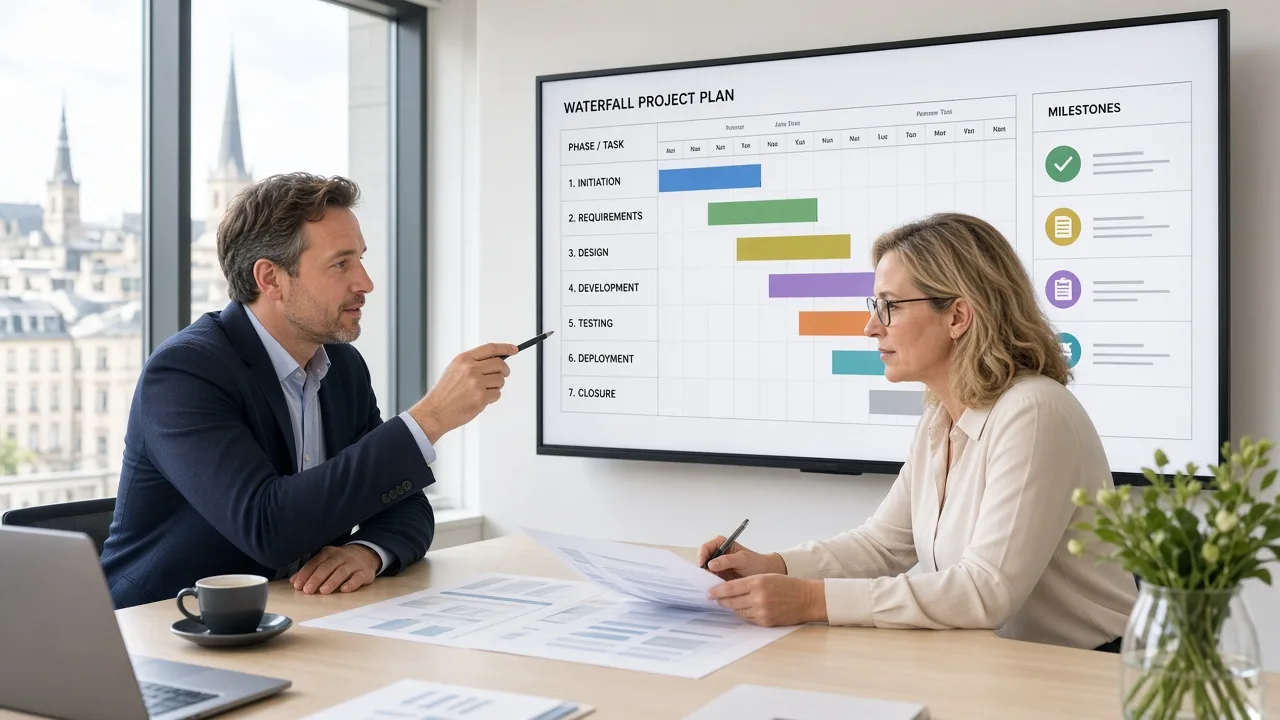
Waterfall moves through distinct phases — requirements, design, development, testing, and deployment — in strict order, with each phase completing before the next begins.
This structured approach works well for projects with clearly defined, unchanging requirements, since teams know exactly what to expect at every stage of the process.
2. Detailed Upfront Planning
Before any development starts, Waterfall requires comprehensive documentation covering every feature, requirement, and specification.
This thorough planning phase takes longer initially but gives stakeholders a clear, complete picture of the final product before any coding begins, reducing ambiguity throughout the rest of the project.
3. Limited Flexibility for Changes
Once a phase is complete, going back to make changes becomes difficult and expensive under Waterfall.
This rigidity works fine for projects with stable requirements but creates real problems if business needs shift mid-project, since adjustments often require reworking completed phases entirely rather than simple incremental tweaks.
4. Clear Milestones and Predictable Timelines
Since each phase has defined deliverables and completion criteria, Waterfall offers more predictable timelines and budgets compared to Agile's more fluid approach.
Businesses that need fixed-cost contracts or clear milestone tracking often prefer this predictability, especially for projects with strict regulatory or compliance requirements.
5. Minimal Client Involvement During Development
Unlike Agile's continuous collaboration, Waterfall typically involves clients heavily during initial planning and final review, with less frequent check-ins during actual development.
This structure suits clients who prefer to approve a plan upfront and receive a finished product, rather than participating in ongoing feedback cycles.
6. Best Suited for Well-Defined, Stable Projects
Waterfall works best when requirements are clear from the start and unlikely to change significantly, like regulatory compliance software or projects with fixed technical specifications.
Businesses building apps in rapidly evolving markets often find this rigidity less suitable than more adaptable, iterative methodologies like Agile.
Agile vs. Waterfall: Which Methodology Fits Your Project
Neither methodology wins in every situation. Whether you're working with an AI development company Luxembourg trusts or a custom software development company Luxembourg businesses rely on for traditional builds, the right choice depends on your project's specific needs.

1. Project Requirements Stability
If your requirements are clear, well-documented, and unlikely to change, Waterfall's structured approach works efficiently.
But if you expect requirements to evolve as you learn more about user needs or market conditions, Agile's flexibility handles that uncertainty far better without derailing the entire project timeline.
2. Client Availability for Ongoing Collaboration
Agile requires consistent stakeholder involvement throughout development, with regular feedback after each sprint.
If your team can't commit to frequent check-ins, Waterfall's structure — heavy involvement upfront and at completion — might fit better, since it doesn't demand the same continuous engagement Agile requires to function well.
3. Timeline and Budget Predictability
Waterfall offers clearer upfront timelines and fixed costs, since the entire project gets planned before development begins.
Agile's iterative nature makes exact timelines harder to predict, though it often delivers value faster through incremental releases.
Businesses needing strict budget certainty often lean toward Waterfall's predictability.
4. Speed to Market Priorities
If getting a functional product to users quickly matters most, Agile's sprint-based approach delivers working features faster, letting businesses start gathering feedback sooner.
Waterfall typically takes longer to produce a usable product, since testing and deployment only happen after all development phases complete sequentially.
5. Project Complexity and Cost Considerations
Complex projects with many interdependent features often benefit from Agile's ability to adjust course as issues surface.
Understanding mobile app development cost in Luxembourg upfront matters for both methodologies, but Agile's flexibility can help control costs by catching problems earlier, before they compound across multiple project phases.
6. Regulatory or Compliance Requirements
Projects with strict regulatory requirements, like healthcare or fintech apps, sometimes benefit from Waterfall's thorough documentation and structured approval process at each phase.
This methodical approach provides clearer audit trails and compliance checkpoints that some regulated industries specifically require throughout the development process.
7. Team Structure and Experience
Agile requires close, ongoing collaboration between cross-functional team members, which works best with experienced, self-organizing teams comfortable with iterative work.
Waterfall's more siloed, sequential structure can suit teams less accustomed to constant collaboration, since each phase has clearer individual ownership and defined handoff points.
8. Risk Tolerance for Changing Direction
Agile allows businesses to pivot based on real user feedback, reducing the risk of building something nobody wants.
Waterfall's rigid structure means committing to a direction early, which works fine for stable, well-understood projects but carries more risk for businesses entering unfamiliar or rapidly evolving markets.
Other Popular Methodologies Used in Luxembourg's App Development Scene
Agile and Waterfall aren't the only options. Many teams at a mobile app development company in Luxembourg work with a blend or choose entirely different approaches depending on project needs. Here are eight other methodologies worth knowing.
1. Scrum
A specific framework within Agile, Scrum organizes work into fixed-length sprints led by a Scrum Master who removes obstacles for the team. Daily stand-up meetings keep everyone aligned on progress and blockers.
This structured version of Agile appeals to teams wanting clear roles and ceremonies within an iterative approach.
2. Kanban
This visual methodology uses boards to track work as it moves through stages like "to do," "in progress," and "done."
Unlike Scrum's fixed sprints, Kanban allows continuous flow, making it ideal for teams handling ongoing maintenance or support work alongside new feature development without rigid time-boxed cycles.
3. Lean Development
Borrowed from lean manufacturing principles, this methodology focuses on eliminating waste, whether that's unnecessary features, delays, or inefficient processes.
Teams prioritize building only what delivers real value to users, testing assumptions quickly, and cutting anything that doesn't contribute directly to the product's core purpose.
4. Hybrid (Agile-Waterfall Combination)
Some teams blend both methodologies, using Waterfall's structured planning for overall project phases while applying Agile's iterative sprints within each phase.
This hybrid approach suits businesses wanting predictable milestones alongside the flexibility to adjust specific features based on ongoing feedback and testing.
5. Extreme Programming (XP)
XP emphasizes technical excellence through practices like pair programming, continuous integration, and test-driven development.
This methodology suits projects where code quality and rapid response to changing requirements matter enormously, particularly for complex applications where bugs could cause significant business or user impact.
6. Feature-Driven Development (FDD)
This methodology organizes development around building and delivering specific client-valued features in short, iterative cycles.
Teams create an overall feature list upfront, then design and build each feature individually. This approach works well for larger teams needing clear structure alongside iterative delivery.
7. Rapid Application Development (RAD)
RAD prioritizes quick prototyping and user feedback over extensive planning, often reducing overall software development cost in Luxembourg by catching design flaws early through rapid iteration.
This methodology suits projects where speed matters more than exhaustive upfront documentation, particularly for MVPs or proof-of-concept builds.
8. DevOps-Integrated Development
This approach merges development and operations teams, emphasizing continuous integration, automated testing, and frequent deployment.
Rather than a standalone methodology, DevOps often layers onto Agile or Scrum, streamlining the path from code completion to live deployment and reducing delays between development and release.
Best Practices for Choosing and Implementing the Right Methodology
Picking a methodology isn't a one-time decision; it requires ongoing evaluation as the project evolves. These six best practices help businesses choose wisely upfront and adapt effectively once development is already underway.

1. Evaluate Your Project's Actual Requirements First
Before choosing a methodology, honestly assess whether your requirements are stable or likely to change. Projects with clear, fixed specifications suit structured approaches like Waterfall, while evolving or exploratory projects benefit from Agile's flexibility.
Matching methodology to actual project characteristics prevents mismatched expectations down the road.
2. Consider Your Team's Experience and Comfort Level
A methodology only works well if the team can execute it effectively. Agile requires comfort with ambiguity and self-organization, while Waterfall suits teams accustomed to clear, sequential handoffs.
Choosing an approach your team hasn't worked with before adds a learning curve that can slow initial progress.
3. Assess Realistic Client Availability
Agile demands consistent stakeholder involvement throughout development, while Waterfall requires less frequent but more concentrated engagement upfront and at completion.
Businesses should honestly evaluate how much time they can commit before choosing a methodology, since mismatched expectations here often lead to frustration on both sides.
4. Start Small Before Committing Fully
For businesses new to Agile or hybrid approaches, running a smaller pilot project first helps teams learn the methodology's rhythm without risking a major initiative.
This trial period reveals whether the chosen approach actually fits the team's working style before scaling it across larger, more complex projects.
5. Maintain Clear Communication Regardless of Methodology
Whether following Agile, Waterfall, or a hybrid approach, consistent communication between developers, stakeholders, and project managers prevents misunderstandings.
Regular updates, clear documentation, and accessible points of contact matter across every methodology, since most project failures stem from communication gaps rather than the framework itself.
6. Stay Flexible to Adjust Mid-Project if Needed
Sometimes a chosen methodology doesn't work as expected once development begins. Businesses shouldn't feel locked into an approach that's clearly causing friction.
Recognizing early signs of mismatch and adjusting, whether shifting to a hybrid model or changing team processes, saves more time than stubbornly continuing a failing approach.
Final Thoughts
Choosing between Agile, Waterfall, or another methodology isn't just a technical decision; it shapes your timeline, budget, and how closely the final app matches what your business actually needs.
Luxembourg's competitive tech and fintech landscape rewards businesses that get this choice right from the start, rather than defaulting to whatever approach a development team happens to prefer.
There's no universally "best" methodology, only the one that fits your project's requirements, team structure, and client involvement realistically.
Whether you land on Agile's flexibility, Waterfall's predictability, or a hybrid approach blending both, the goal remains the same: building software that performs well and adapts as your business grows.
Frequently Asked Questions (FAQs)
Which methodology is best for startups?
Agile typically suits startups best, since it allows quick pivots based on user feedback and market changes, letting founders adjust direction without abandoning months of completed work.
Is Waterfall outdated for mobile app development?
Not entirely. Waterfall still works well for projects with fixed, well-defined requirements, like regulatory compliance software, where predictable timelines matter more than iterative flexibility.
Can I combine Agile and Waterfall on the same project?
Yes. Many businesses use a hybrid approach, applying Waterfall's structured planning to overall phases while using Agile sprints within each phase for flexibility.
How does methodology choice affect development cost?
Waterfall offers more predictable, fixed costs upfront, while Agile's flexibility can control costs by catching issues earlier, though total cost may vary as scope evolves.
What's the difference between Agile and Scrum?
Scrum is a specific framework within Agile, using defined roles, sprints, and ceremonies. Agile is the broader philosophy, while Scrum provides one structured way to implement it.
How much client involvement does Agile require?
Agile requires regular check-ins, typically after each sprint, so clients should expect to review progress and provide feedback every two to four weeks throughout development.
Is Kanban better than Scrum for ongoing app maintenance?
Kanban often works better for maintenance work, since it supports continuous flow without fixed sprint cycles, making it easier to handle unpredictable support requests alongside new features.
Can I switch methodologies mid-project if it's not working?
Yes, though it requires careful planning. Recognizing early signs of mismatch and adjusting, even mid-project, often saves more time than continuing with an approach that isn't working.
Does methodology choice affect app quality?
Methodology itself doesn't determine quality directly, but the right fit for your project reduces miscommunication and rework, which indirectly leads to a more polished final product.
How do I know which methodology my development partner uses?
Ask directly during initial conversations. A transparent development partner should clearly explain their process, including how they handle changes, communication, and project milestones.