
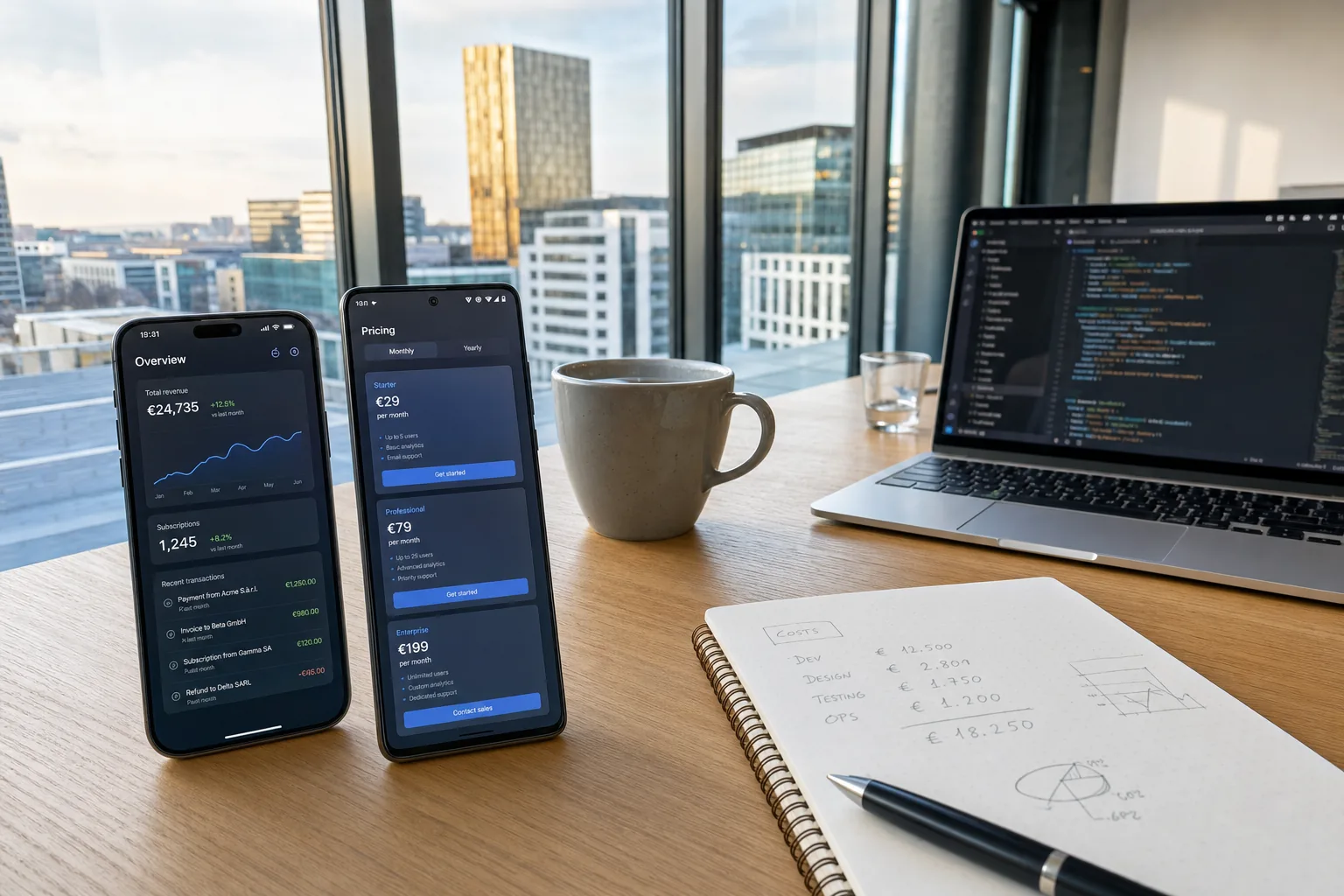
Choosing how to build your mobile app is one of the most consequential decisions a business makes before development even begins.
Companies in Luxembourg increasingly face this choice: hire an in-house team with full control and long-term investment, or outsource to an external development partner offering flexibility and specialized expertise.
Each approach comes with distinct cost structures, benefits, and risks that directly affect timelines, budgets, and long-term scalability.
In-house teams offer closer collaboration but demand significant upfront investment, while outsourcing provides access to broader talent pools at potentially lower costs, though it introduces its own communication and quality-control challenges.
This guide breaks down both models in detail, comparing real costs, weighing genuine benefits and risks, and helping you decide which approach truly fits your project's goals and resources.
Understanding Outsourcing and In-House Development Models
Whether working with an established AI development company Luxembourg businesses trust or building an internal team, understanding these two models lays the groundwork for smarter, more informed development decisions.
Why the outsourcing market keeps expanding
The global IT outsourcing market reached $638.65 billion in 2026 and is projected to grow to $752 billion by 2031, reflecting how widely businesses now rely on external development partners.
Why in-house teams remain valuable despite this shift
In-house developers offer closer collaboration, deeper product knowledge, and direct oversight, making them ideal for companies prioritizing long-term control over speed or short-term cost savings.
Why talent access is reshaping outsourcing decisions
Cost reduction as the primary outsourcing driver fell from 70% in 2020 to just 34% in 2026, replaced by talent access and speed to market, showing outsourcing is increasingly about capability rather than cost alone.
Key Benefits and Risks of Each Approach
Both outsourcing and in-house development bring genuine advantages alongside real trade-offs.
Understanding these benefits and risks in detail helps businesses make informed decisions rather than choosing based on cost alone, ensuring the selected model truly fits long-term project goals and constraints.
1. Benefit: Cost Flexibility With Outsourcing
Outsourcing typically reduces upfront costs since businesses avoid salaries, benefits, and infrastructure expenses tied to full-time hires.
This flexibility allows companies to scale development effort up or down based on project needs and budget availability.
2. Risk: Communication Gaps in Outsourced Projects
Choosing partners for mobile app development in Luxembourg across different time zones or cultures can introduce communication delays.
Misaligned expectations or unclear requirements sometimes lead to revisions that slow down timelines and increase costs.
3. Benefit: Deeper Product Knowledge In-House
In-house teams build lasting familiarity with company goals, systems, and users over time. This deeper understanding often results in more thoughtful decisions and stronger alignment between development work and broader business objectives.
4. Risk: Higher Fixed Costs With In-House Teams
Maintaining a full in-house team requires ongoing salaries, benefits, training, and infrastructure investment, regardless of project workload. This fixed cost structure can strain budgets during slower periods or unpredictable development cycles.
5. Benefit: Access to Specialized Global Talent
Outsourcing opens access to specialized skills, such as AI integration or advanced UX design, that may be difficult or expensive to hire locally. This broadens what's realistically achievable within a given project budget.
6. Risk: Quality Control Challenges Without Oversight
Without direct daily oversight, maintaining consistent quality in software development in Luxembourg projects handled remotely can be challenging.
Clear contracts, milestones, and regular check-ins help mitigate this risk throughout the development process.
Comparing Costs: Outsourcing vs In-House Development in Luxembourg
Understanding mobile app development cost in Luxembourg requires comparing both models side by side, with outsourcing typically ranging between €8,000 and €60,000, compared to €12,000 and €90,000 for in-house development.
| Cost Category | Key Activities | Outsourcing Cost | In-House Cost |
|---|---|---|---|
| Discovery & Planning | Market research, scope definition, feasibility study | €800 – €1,800 | €1,200 – €2,800 |
| UI/UX Design | Wireframes, prototypes, design systems | €1,800 – €5,500 | €2,800 – €8,000 |
| Frontend Development | Screens, navigation, animations | €5,500 – €14,000 | €8,000 – €20,000 |
| Backend Development | Servers, databases, API architecture | €4,500 – €13,000 | €7,000 – €19,000 |
| Third-Party Integrations | Payment gateways, maps, social logins | €1,200 – €4,500 | €1,800 – €6,500 |
| AI & Automation Features | Personalization, chatbots, recommendations | €2,800 – €9,500 | €4,200 – €13,500 |
| Quality Assurance & Testing | Bug fixes, device testing, security checks | €1,200 – €4,000 | €2,000 – €6,000 |
| App Store Deployment | Submission, compliance, store optimization | €400 – €1,200 | €700 – €1,800 |
| Post-Launch Maintenance (Monthly) | Updates, monitoring, minor fixes | €500 – €1,500 | €900 – €2,500 |
| Team Overhead & Infrastructure | Salaries, benefits, tools, workspace | €600 – €1,800 | €2,500 – €9,900 |
| Factor | Outsourcing | In-House |
|---|---|---|
| Hiring & Onboarding Time | 1–3 weeks | 6–12 weeks |
| Long-Term Cost Stability | Variable, project-based | Fixed, ongoing |
| Talent Pool Access | Global, specialized | Local, limited |
| Scalability | High flexibility | Requires hiring/firing |
How to Choose the Right Model for Your Project?
Selecting between outsourcing and in-house development ultimately comes down to your specific goals, timeline, and budget.
Understanding software development cost in Luxembourg for both models helps you make a decision grounded in real numbers rather than assumptions.
1. Assess Your Project's Complexity
Highly specialized or feature-heavy apps often benefit from outsourced expertise, while simpler, ongoing projects may be easier to manage with a smaller in-house team over time.
2. Consider Your Long-Term Product Roadmap
If you're building a product requiring continuous updates and evolution, an in-house team offers consistency and deeper institutional knowledge that outsourced partners typically cannot fully replicate.
3. Evaluate Your Available Budget
Partnering with an established custom software development company Luxembourg businesses trust can reduce upfront costs significantly, making outsourcing appealing for startups or companies with limited initial capital.
4. Determine Your Need for Control
Projects requiring tight oversight, frequent pivots, or close collaboration with internal stakeholders generally favor in-house teams, where daily communication and adjustments happen far more naturally.
5. Factor In Your Timeline Requirements
Outsourcing often accelerates timelines by providing immediate access to experienced developers, avoiding the lengthy recruitment and onboarding process required when building an internal team from scratch.
6. Weigh Data Security and Confidentiality Needs
Sensitive projects involving proprietary technology or strict compliance requirements may favor in-house development, where data control remains entirely internal rather than shared with an external partner.
7. Think About Scalability Needs
Outsourcing offers easier scalability, letting you expand or reduce team size based on project phase, without the long-term commitment and cost associated with hiring or laying off in-house staff.
8. Consult Experts Before Committing
Speaking with a reputable mobile app development company Luxembourg founders rely on can help clarify realistic costs and timelines for both models before making a final, informed decision.
Conclusion
Deciding between outsourcing and in-house development ultimately depends on your project's complexity, budget, timeline, and long-term goals rather than a one-size-fits-all answer.
Outsourcing offers cost flexibility, faster onboarding, and access to specialized global talent, while in-house teams provide deeper product knowledge, tighter control, and long-term consistency for evolving products.
Both models come with genuine trade-offs, and understanding these differences in detail helps businesses avoid costly missteps before development even begins.
Whether you prioritize speed and affordability or control and continuity, weighing real costs against your specific needs will lead to a decision that supports your app's success well beyond the initial launch.
Frequently Asked Questions (FAQs)
Is outsourcing always cheaper than in-house development?
Generally yes for upfront costs, though in-house teams can become more cost-effective long-term for ongoing, large-scale projects requiring continuous development and support.
How long does it take to build an in-house development team?
Recruiting, hiring, and onboarding a full in-house team typically takes six to twelve weeks, compared to just one to three weeks when partnering with an outsourced provider.
Can I switch from outsourcing to in-house development later?
Yes, many companies start by outsourcing to validate their product, then transition to an in-house team once the business scales and requires tighter ongoing control.
What industries benefit most from in-house development?
Industries handling sensitive data, strict compliance requirements, or highly proprietary technology, such as finance or healthcare, often benefit most from in-house development's added control.
Does outsourcing mean sacrificing quality?
Not necessarily. Working with an experienced, reputable development partner and maintaining clear communication, milestones, and contracts can ensure high-quality results comparable to in-house work.
Is a hybrid model between outsourcing and in-house possible?
Yes, many companies use a hybrid approach, keeping core strategic roles in-house while outsourcing specialized tasks like UI/UX design or specific technical development work.
How do time zone differences affect outsourced projects?
Time zone gaps can slow communication and feedback loops, though many outsourcing partners offer overlapping working hours or structured check-ins to minimize delays.
What is the biggest hidden cost of in-house development?
Ongoing overhead, including salaries, benefits, training, and infrastructure, often gets underestimated, making total in-house costs higher than initially planned during budgeting.
How do I ensure data security when outsourcing?
Signing clear NDAs, using secure development environments, and vetting partners' security practices thoroughly are essential steps to protect sensitive data during outsourced projects.
Which model is better for a startup building its first app?
Startups often benefit from outsourcing initially, since it reduces upfront costs and provides flexibility while testing product-market fit before committing to a permanent team.